Can a CRM forecast revenue based on pipeline data?

Yes, a CRM can forecast revenue from pipeline data by combining open deal values, expected close dates, and the likelihood of winning each opportunity. The forecast is an estimate—not booked revenue or cash collected—and its usefulness depends on current records and probabilities grounded in actual sales outcomes.
- Can a CRM forecast revenue based on pipeline data? Yes, but pipeline value alone is not a forecast.
- Weighted pipeline forecasting combines deal amounts, win probabilities, and expected close dates.
- Arches CRM suits growing sales teams that need pipeline management and automated follow-ups.
- Keep forecasted bookings, recognized revenue, and cash receipts separate.
Can a CRM forecast revenue based on pipeline data?
A CRM can turn pipeline records into a sales forecast when each opportunity has a value, a realistic closing period, and a defensible probability of winning. Adding every open opportunity together gives you total pipeline value, not expected sales.
The basic weighted calculation is:
Weighted pipeline forecast = sum of each eligible deal amount multiplied by its win probability.
Eligible means the opportunity belongs in the period you are forecasting. For a 2026 forecast, a deal expected to close outside 2026 does not belong in that period's closing forecast simply because it remains open.
Keeping those records current is an operational requirement. See how workflow automation reduces manual CRM data entry before adding more reporting work for your reps.
| Forecasting approach | Best for | Main benefit | Main limitation |
|---|---|---|---|
| Weighted pipeline | Teams with clear stages and usable historical outcomes | Makes assumptions visible and calculations explainable | Broad stage probabilities miss differences between deals |
| Rep-assessed forecast | Teams reviewing specific buyer commitments | Adds context about approvals, timing, and obstacles | Depends on consistent judgment and supporting evidence |
| Historical forecasting | Teams with comparable past sales periods | Provides a baseline independent of individual deal opinions | Past results do not automatically reflect a changed business |
These approaches answer different questions. Use the comparison to choose a starting point, not to assume every CRM includes every forecasting method.
Why this matters
A lead arrives, a rep sends a proposal, and the opportunity stays open. Without an updated close date or a documented next step, that proposal can remain in the forecast long after the buyer's timeline changes.
The reporting problem starts in the sales process. A forecast cannot distinguish progress from wishful thinking unless your pipeline records that distinction.
For your 2026 planning, define what the forecast represents before using it to guide hiring, spending, or delivery capacity. Expected signed contracts, recognized revenue, and expected customer payments are different measures.
A closed-won opportunity records a sales outcome. Finance determines when that sale becomes recognized revenue under the applicable accounting rules; payment timing determines when cash arrives.
Weighted pipeline forecasting
Best for: teams that need an explainable starting point and have consistent pipeline stages. Weighted pipeline forecasting assigns a probability to each eligible opportunity and totals the resulting weighted amounts.
Stage-based weighting uses the deal's current stage to determine its probability. Ground that probability in historical outcomes for comparable opportunities rather than treating a stage name as proof of buying intent.
The advantage is transparency. A manager can inspect the included deals, their amounts, and their assigned probabilities without interpreting an unexplained score.
The limitation is that deals in the same stage do not necessarily carry the same risk. A proposal with confirmed budget and an active decision-maker differs from a proposal sent without a scheduled follow-up.
Start with weighted forecasting when your stage definitions are clear, then review the assumptions behind material opportunities. Do not confuse a mathematically correct total with a well-supported prediction.
Rep-assessed forecasting
Best for: teams whose opportunities depend on buyer approvals, negotiations, or other deal-specific conditions. A rep-assessed forecast adds documented judgment about whether an opportunity will close during the selected period.
Ask the owner to explain what supports the expected outcome. Useful evidence includes an agreed next meeting, a confirmed approval process, or a buyer-stated decision timeline.
The advantage is context. A rep can explain an obstacle that a stage-based calculation does not capture.
The limitation is subjectivity. If one rep treats a verbal expression of interest as a commitment while another requires completed approvals, their forecasts are not comparable.
Use shared evidence standards before accepting rep commitments. Keep the original calculation visible alongside any judgment-based adjustment so managers can see what changed and why.
Historical forecasting
Best for: teams with recorded outcomes from comparable selling periods. Historical forecasting uses past sales patterns as a baseline for expected future results.
Historical results also help check pipeline assumptions. Compare the win rates assigned to stages with the actual outcomes of opportunities that previously reached those stages.
The advantage is an outcome-based reference point. It gives you a way to question an optimistic pipeline without relying only on a manager's opinion.
The limitation is comparability. Changes in your offer, customer mix, qualification rules, or sales process affect how useful past results are for a 2026 forecast.
Use history as a baseline, not a substitute for reviewing current conditions. Keep different sales motions separate when combining them would hide meaningful differences in deal behavior.
Why CRM revenue forecasts vary
Forecast differences come from the records included and the assumptions applied. Review these factors before blaming the calculation:
- Deal values: Use a consistent definition of opportunity amount. Mixing recurring amounts with full contract values produces a total with no clear meaning.
- Expected close dates: Base timing on the buyer's process and remaining work. A target date entered by a rep is not a customer commitment.
- Stage definitions: Require observable entry criteria. Proposal sent and proposal accepted describe different evidence.
- Win probabilities: Check probabilities against completed outcomes. Unsupported percentages create an appearance of precision without a defensible basis.
- Pipeline condition: Review duplicates, stalled opportunities, and deals without a next action. Their inclusion changes the forecast even when the formula stays unchanged.
- Historical comparability: Separate records when customer types, sales processes, or contract structures differ enough to distort a shared assumption.
Fix the inputs before adding complexity. A more elaborate forecast still depends on the quality of the opportunities underneath it.
How do you build a usable CRM pipeline forecast?
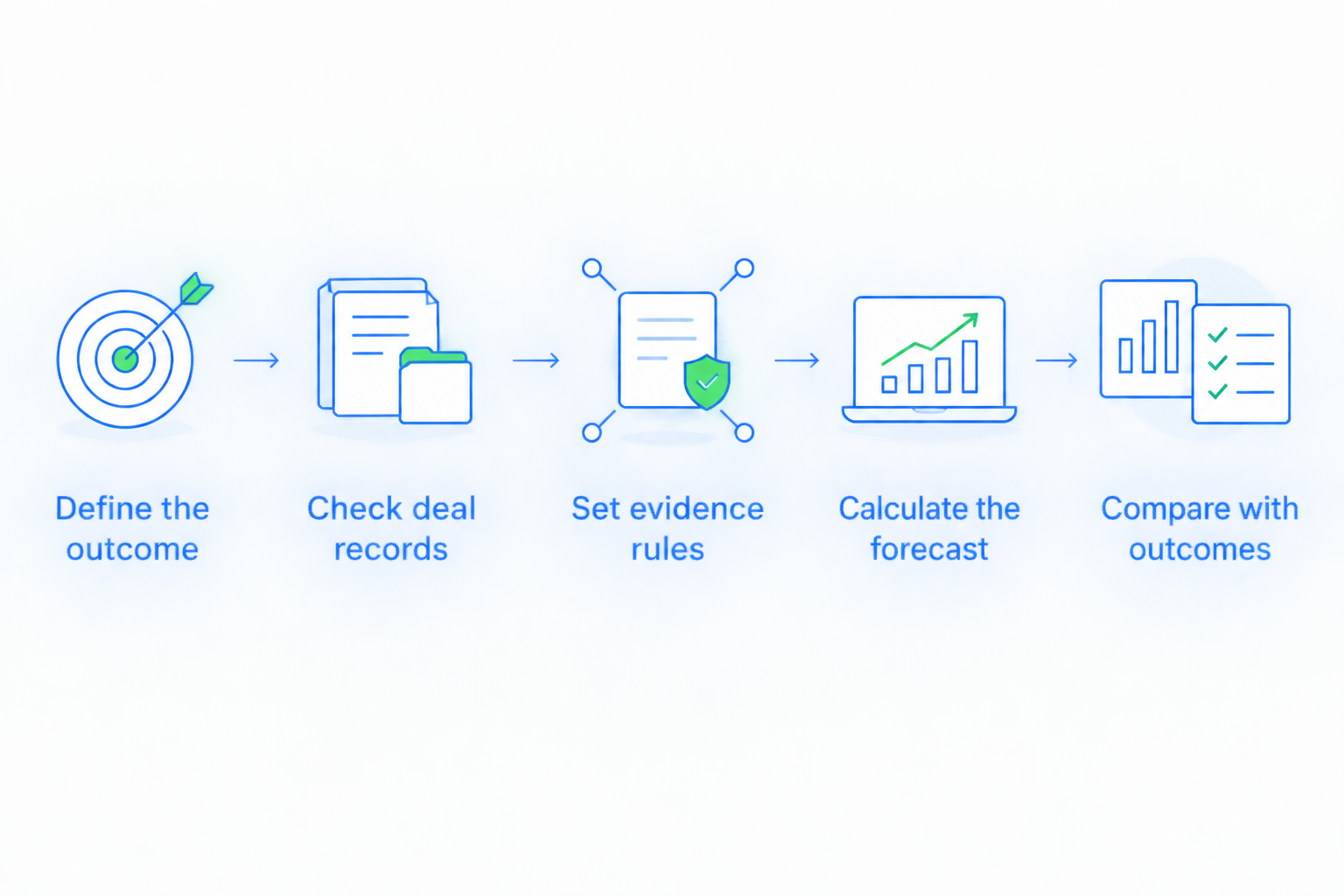
Use this sequence to establish a forecast your team can explain. The work starts with definitions, not a dashboard.
Define the outcome
Choose whether you are forecasting bookings, recognized revenue, or cash receipts. State the period, currency treatment, and deal-value definition alongside the report.
For a 2026 bookings forecast, include opportunities expected to become signed business during 2026. Do not label that total cash flow unless payment schedules are part of the calculation.
Check deal records
Review each included opportunity for an owner, an amount, a stage, an expected close date, and a documented next step. Resolve missing or contradictory information before calculating the total.
Check that the same commercial opportunity is not represented by duplicate records. Contact duplication and opportunity duplication are separate issues; merging contacts does not itself establish which deals belong in a forecast.
Set evidence rules
Write down what qualifies a deal for each stage and forecast category. Describe buyer actions or completed milestones rather than the rep's confidence alone.
A useful rule tells a manager what evidence to look for. It also tells a rep exactly what information needs updating after a customer conversation.
Calculate the forecast
Filter the pipeline to the selected period, apply the chosen assumptions, and total the eligible amounts. Keep the underlying deal list accessible so the number can be traced back to individual opportunities.
If managers adjust the calculated forecast, record the reason separately. An unexplained override makes it harder to learn whether the model or the judgment was wrong.
Compare with outcomes
Preserve the forecast as it stood when the decision was made. Compare that snapshot with completed sales after the period closes.
Review whether differences came from lost deals, delayed signatures, changed amounts, or opportunities that entered later. Each cause calls for a different correction.
What should you ask during a CRM forecasting demo?
Ask the vendor to explain a forecast from the total down to the underlying deals. A chart is not enough; you need to understand what qualifies for inclusion and how changes affect the result.
Request a demonstration of these checks:
- Filter opportunities by the expected closing period.
- Inspect the source of a deal's win probability.
- Change an amount or close date and inspect the effect.
- Separate open pipeline from completed sales.
- Explain how forecast snapshots and later outcomes are compared.
- Show how missing values and duplicate opportunities are handled.
Treat each item as a capability to verify, not a standard feature every platform includes. Also confirm who maintains stage rules and probability assumptions after setup.
For your 2026 selection process, prioritize traceability over visual polish. You should be able to explain why an opportunity contributes to the forecast without depending on an unexplained score.
Where does Arches CRM fit?
Arches CRM is best for growing sales teams that need CRM pipeline management and automated follow-ups in one place. It brings contacts, conversations, tasks, and sales activity together, with opportunity movement based on customer interactions and configured workflows.
That supports the recordkeeping a forecast depends on: current conversations, assigned work, and visible deal progress. Arches CRM also provides sales reporting, but pipeline automation and a dedicated forecasting model are different capabilities.
The benefit is a connected sales workflow. The boundary is that automatic stage movement does not, by itself, establish a deal's probability of closing or determine when revenue should be recognized.
Before selecting Arches CRM for a forecasting requirement, verify the specific calculations, probability controls, and historical comparisons your process needs. Choose the platform against your reporting requirements, not against the assumption that every CRM forecast works the same way.
Is pipeline value the same as forecasted revenue?
No. Pipeline value totals open opportunities, while a forecast applies assumptions about which opportunities will close and when.
Keep both measures visible. Pipeline value describes the opportunity pool; the forecast estimates an outcome for a defined period.
Can a CRM forecast without historical sales data?
Yes, a CRM can calculate a forecast using manually assigned assumptions without historical sales data. Those assumptions are not validated win rates, so label them clearly and compare them with completed outcomes as evidence accumulates.
Does moving a deal forward make the forecast more accurate?
No. Advancing a deal changes the forecast only according to the rules applied, and accuracy depends on whether the new stage reflects genuine buyer progress.
A reply can confirm interest, request a delay, or reject the offer. The meaning of the interaction matters more than the fact that an interaction happened.
FAQ
Can a CRM forecast revenue based on pipeline data?
Yes, a CRM can forecast expected sales using deal amounts, expected close dates, and win probabilities. The result is an estimate, not a guarantee of recognized revenue or customer payments.
What's the difference between a sales pipeline and a sales forecast?
A sales pipeline records opportunities and their progress, while a sales forecast estimates outcomes for a defined period. Total open pipeline value does not account for every opportunity's timing or likelihood of closing.
What's the best CRM forecasting method to start with?
Weighted pipeline forecasting is a practical starting point when your team has consistent stages and defensible probabilities. Review deal-specific evidence alongside the calculated total.
Can I forecast sales if my business has no sales history?
Yes, you can calculate a sales forecast using explicitly stated assumptions. Treat those assumptions as provisional and revise them against completed sales outcomes.
Does a closed-won deal count as cash received?
No, a closed-won deal does not establish that payment has arrived. Track payment timing separately from sales outcomes and recognized revenue.
How can I check whether my CRM forecast is accurate?
Compare a saved forecast with completed outcomes for the same period and value definition. Investigate differences caused by losses, delayed closes, changed amounts, and newly added deals.
Can automated pipeline updates replace a sales forecast review?
No, automated pipeline updates do not replace a review of buyer evidence and forecast assumptions. Check that stage changes reflect the actual meaning of customer interactions.
One last thing
Save the forecast before you judge it. If you compare completed sales with a report that has already absorbed every late update, you are not evaluating the prediction your business originally used.
Preserve the assumptions and opportunity list behind each decision. That makes the next forecast a learning process rather than another debate about whose number feels right.